

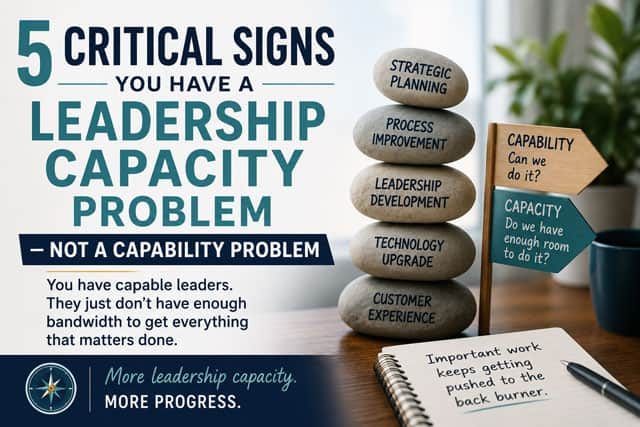
When important work isn’t getting done, it’s easy to question leadership capability. Do we have the right people? Do they have the skills? Are they capable of moving this forward? But sometimes capability isn’t the problem at all. The real issue is leadership capacity.
You can have talented, experienced leaders who know exactly what needs to be done—and still watch important priorities stall. Why? Because capable people have limits. When everyone is already flying at full throttle, adding one more priority doesn’t necessarily create more progress.
IS IT CAPABILITY — OR CAPACITY?
Before you decide you have a leadership capability problem, look for these five signs that you may actually need more leadership capacity:
- Important priorities keep getting pushed back. Everyone agrees they matter, but something more urgent always takes precedence.
- Your strongest leaders are carrying too much. The people you trust most become the default choice for every new challenge. Eventually, even your best people run out of bandwidth.
- Projects start, but momentum fades. The kickoff meeting happens. Everyone is enthusiastic. Then daily demands take over and the initiative slowly moves to the back burner.
- Decisions are bottlenecked. Too many projects depend on the same one or two people for direction, approval, or follow-through.
- Everyone is busy, but progress is hard to see. Activity and progress aren’t the same thing. A full calendar can actually disguise a shortage of leadership capacity.
So, what’s happening in your organization? Are your leaders missing the skills to move an important priority forward—or are capable people simply stretched too thin? And what could move forward if someone had the capacity to take ownership of it?
Sometimes you don’t need to hire another full-time executive or develop entirely new capabilities. You simply need to add enough leadership capacity to create some room to maneuver. That’s one of the reasons I provide fractional executive support: to step in when capable organizations need additional leadership capacity to regain momentum and turn stalled priorities into progress. You haven’t peaked yet!